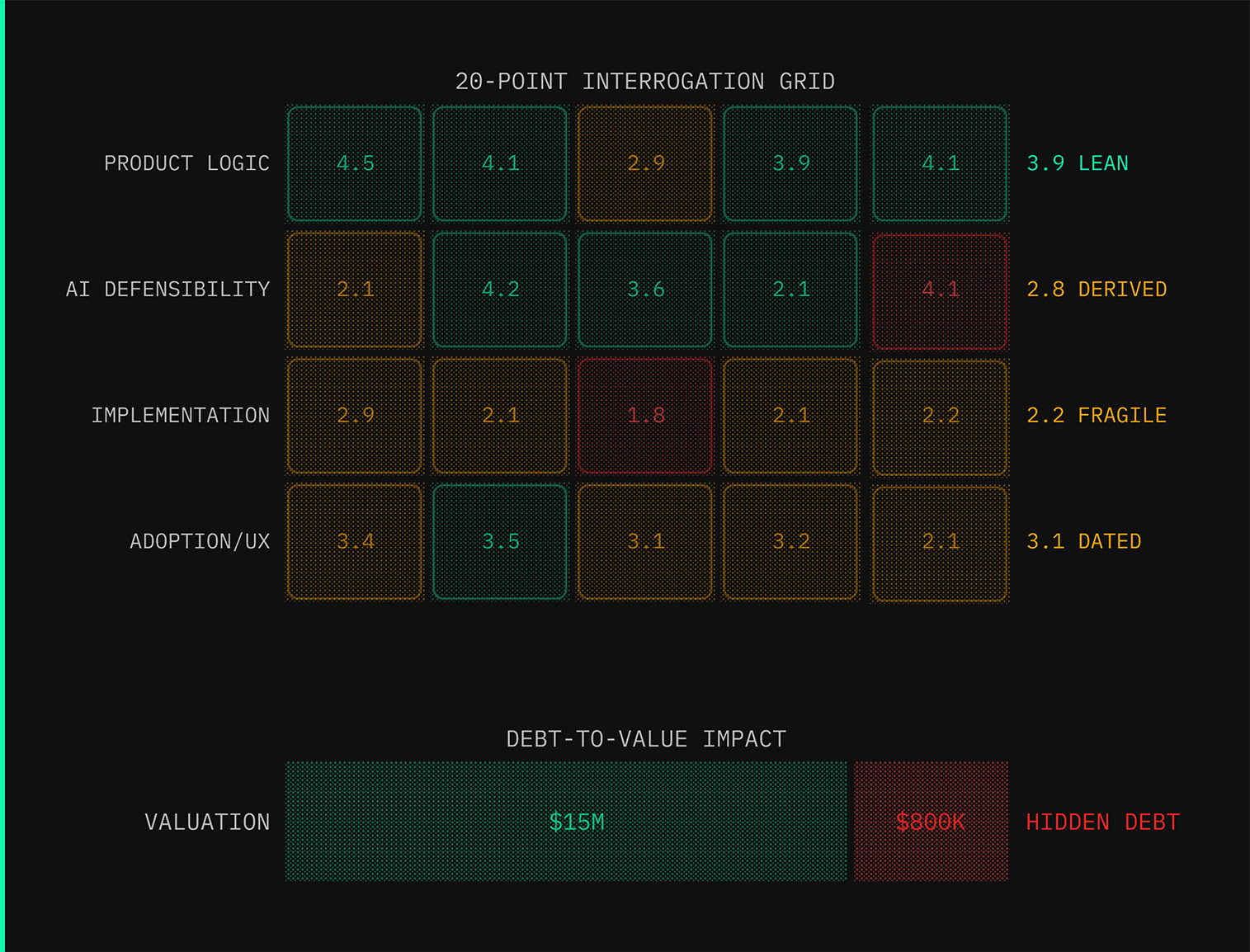
Every deal prices the financials. Almost none price the software, so the buyer's team does, under pressure and on belief, and turns what they find into leverage. The Strike Verdict™ is a certified, independent read of a company's product and technology: 4 core elements across 20 measurements, scored and delivered in 72 hours. A seller sees exactly what that diligence will surface, in time to fix it, pre-frame it, and defend their valuation. A buyer sees where to aim it, and whether the expensive work is worth commissioning at all.
Deal cycles are compressing on both sides of the table. Buyers are writing larger checks, faster; sellers are defending valuations against tighter windows. Traditional diligence timing serves neither.
Capital is chasing software and AI assets at 2.6x last year's pace. Every one of those deals prices a technology story, and most price it on belief.
The most active M&A sector by volume, again. Each transaction is a technical read that either happened rigorously or it didn't.
The largest deal value of any sector. Capital commits at that scale on a technology story it usually can't fully see.
Data Source: EY-Parthenon US M&A Insights, July 2026 edition · Market intelligence reviewed quarterly
The tech stack is the least-understood, least-priced part of most software deals; not because the information doesn't exist, but because no one asks the right twenty questions before the terms are set. By the time the technical picture comes into focus, the deal has shaped around incomplete information, for whichever side moved without it.
Within 72 hours, a certified assessment scores the target across our framework, surfacing the structural risks that carry a cost. One engagement serves one side: the same certified instrument, pointed where its client sits.
Signed once, the Verdict standing at every stage.
A scored read of the product and engineering layers, certified in 72 hours. It shows where the deep work will earn its cost, and which targets warrant it.
Your team starts from a scored map. Twenty measurements, flagged and traced to evidence, so the deep hours land where the risk concentrates.
The remediation plan arrives priced and sequenced: what to address, in what order, at what staffing. Day one begins with a plan in hand.
Now you are the seller. The same certified record, chain intact and signed, stands as evidence for the valuation you are defending.
Twenty measurements across four core elements cut through target-provided summaries to establish what's structurally true about the asset; surfacing the technical debt, architectural risk, and execution gaps that a decision turns on. The verdict is derived, not asserted; every figure traces back to what was measured.
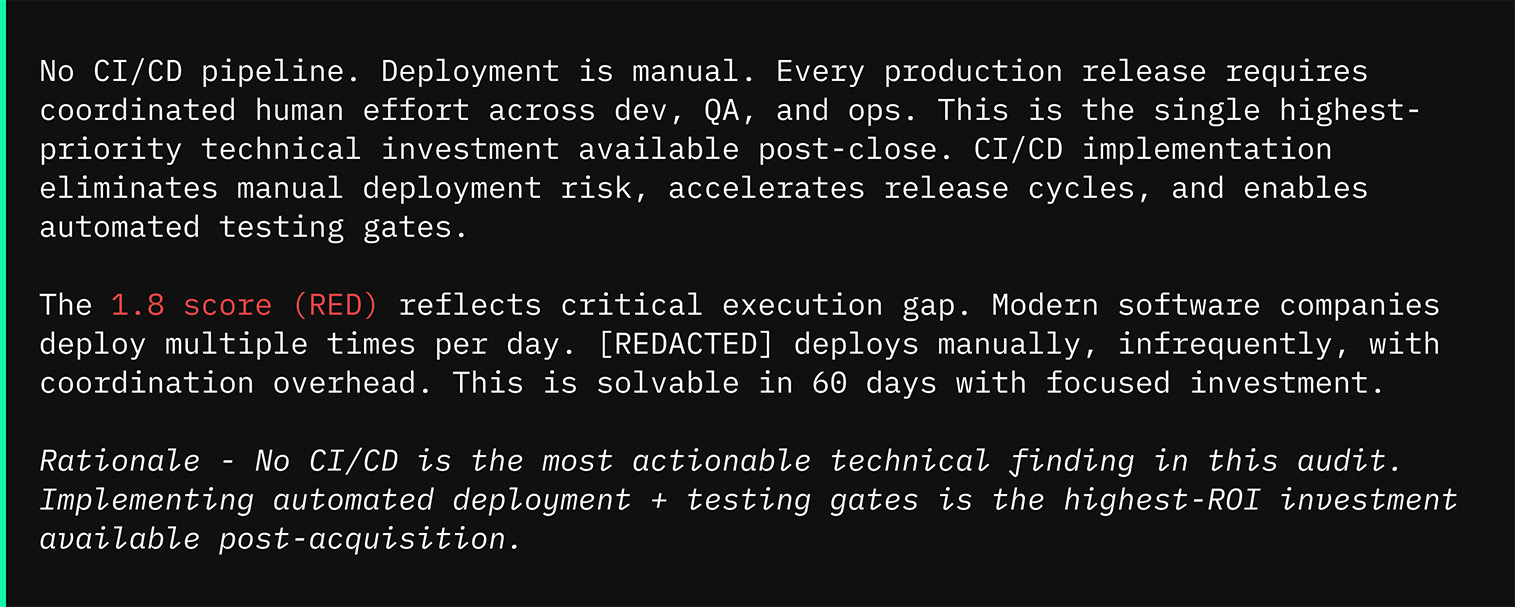
In a reference assessment of an enterprise security company, The Strike Verdict surfaced a critical execution risk sitting behind seemingly healthy performance metrics.
That single finding, an unpriced remediation cost flagged and traced to evidence, is what a deal team would have had in hand before the check was signed.
Representative example. Details generalized to protect client confidentiality.
One person can only look at so many targets, and the deep work takes weeks you rarely have. A certified first-pass read covers ten in the time it takes to do one properly.
It never makes the call. It scores what is observable, labels what it could not establish, and stops. What it gives you is a place to aim, so the weeks you do spend land where the risk actually sits.
And it gives you a position. A certified record with a name and a signature that are not yours, carrying evidence you did not have to produce. Your judgment, with something independent standing behind it.
Most technical assessments come from firms that also deliver what the assessment recommends: the fractional executives, the remediation program, the integration work. That is a normal way to build a services business, and it means the finding and the fee are connected.
Strike Team tells you what to fix, in what order, at what cost. Then we stop. No remediation contract, no integration work, no staffing sits on the other side of a flagged finding. The only thing a Verdict can lead to is another read on more evidence, never work on the asset itself.
That independence is attested, not asserted. Every assessor and the Editor-in-Chief confirms it before a verdict is signed: no financial interest in the target or acquirer, no compensation tied to the verdict, the score, or whether the deal proceeds, and no advisory or employment relationship within the past three years. Any prior relationship, however far back, is declared in the Verdict itself with the safeguards stated. Assessors are barred from taking roles with assessed parties for a year after signature. The attestations render in every Verdict, by name and date. An engagement without them isn't certified.
"In an era where the speed of software creation is outstripping the speed of evaluation, architectural truth is the only real leverage."
My career has been fueled by a singular obsession: bringing to life novel, complex, and market-shaping software. I spent 27 years in the trenches of Enterprise B2B and SaaS because those environments demand a rare, intimate synthesis of product strategy, user experience, and deep-system engineering. This isn't just a profession; it is where my mental capacity goes when idle.
Across those decades, I navigated multiple M&A cycles and watched Enterprise SaaS architecture undergo a fundamental phase shift. Systems that once took years to build are now deployed in months, accelerated by AI-native complexity and cloud-scale infrastructure. It is an era of incredible innovation, but it has created a new kind of "structural noise" that makes the foundational truth of an asset harder than ever to see.
While advising at Trailhead, immersed at the seed stage of the startup space, I saw it clearly: software creation is outstripping evaluation speed. The standard models of diligence were built for a static era; today's investors and sellers are navigating high-speed deal cycles where technology clarity is the primary lever of outcome, on both sides of the table.
Strike Team is the result: a certified instrument for establishing what's true about a software asset's product and technology. Every Strike Verdict™ is signed by the Editor-in-Chief; the score is the standard, and the signature is the accountability behind it. The tool was never the deliverable. The judgment is.
Founder & Editor-in-Chief
Share your details below, sell-side or buy-side, then pick a time for a brief scoping call, or leave it to us and we'll follow up by email. Strike Team works through a small set of deal-flow relationships and takes on a limited number of engagements each month, so we read every inquiry ourselves.